
Options Analytics Engine
GPU-accelerated options analytics for serious derivatives research: multi-leg strategies, volatility surfaces, path-dependent payoffs, and intraday Greeks at scale.
Engine telemetry
Live-style snapshot of an options portfolio. Behavior matches the planned GPU engine.
+2.41%
+$8.3k vs spot
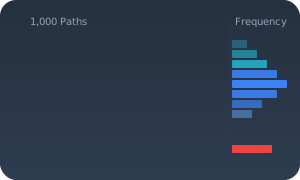
Monte Carlo:
100k paths · 30D
GPU target: 10M+ paths/s
Built for systematic options research
The Options Engine is designed to feel like the options-native twin of the VectorAlpha Backtester: same focus on speed and correctness, but with a derivatives-first risk model.
;%20}%20100%25%20{%20opacity:%201;%20transform:%20scaleY(1);%20}%20}%20/*%203.%20The%20Legs%20(Nodes)%20Popping%20In%20*/%20@keyframes%20pop-leg%20{%200%25%20{%20transform:%20scale(0);%20}%2050%25%20{%20transform:%20scale(1.5);%20}%20100%25%20{%20transform:%20scale(1);%20}%20}%20.graph-path%20{%20stroke-dasharray:%20150;%20stroke-dashoffset:%20150;%20/*%20Start%20hidden%20*/%20animation:%20draw-graph%207s%20ease-out%20forwards%20infinite;%20animation-delay:%200.5s;%20}%20.profit-area%20{%20transform-origin:%20bottom;%20animation:%20fade-fill%207s%20ease-out%20forwards%20infinite;%20animation-delay:%200.5s;%20}%20.leg-node%20{%20transform-box:%20fill-box;%20transform-origin:%20center;%20animation:%20pop-leg%207s%20cubic-bezier(0.175,%200.885,%200.32,%201.275)%20infinite;%20}%20/*%20Stagger%20the%20nodes%20appearance%20*/%20.leg-1%20{%20animation-delay:%200s;%20}%20.leg-2%20{%20animation-delay:%200.2s;%20}%20.leg-3%20{%20animation-delay:%200.4s;%20}%20.leg-4%20{%20animation-delay:%200.6s;%20}%20%3c/style%3e%3crect%20width='120'%20height='120'%20rx='24'%20fill='url(%23bg-fintech)'%20fill-opacity='0.95'%20/%3e%3cg%20stroke='%23334155'%20stroke-width='0.5'%20opacity='0.5'%3e%3cline%20x1='20'%20y1='60'%20x2='100'%20y2='60'%20/%3e%3cline%20x1='60'%20y1='20'%20x2='60'%20y2='100'%20stroke-dasharray='2%202'/%3e%3c/g%3e%3cg%20transform='translate(0,%205)'%3e%3cpath%20class='profit-area'%20d='M%2030%2060%20L%2045%2035%20L%2075%2035%20L%2090%2060%20Z'%20fill='url(%23profit-fill)'%20/%3e%3cpath%20class='graph-path'%20d='M%2015%2075%20L%2030%2060%20L%2045%2035%20L%2075%2035%20L%2090%2060%20L%20105%2075'%20fill='none'%20stroke='url(%23strategy-line)'%20stroke-width='2.5'%20stroke-linecap='round'%20stroke-linejoin='round'%20/%3e%3ccircle%20cx='30'%20cy='60'%20r='2.5'%20fill='%23fff'%20class='leg-node%20leg-1'%20/%3e%3ccircle%20cx='45'%20cy='35'%20r='2.5'%20fill='%23fff'%20class='leg-node%20leg-2'%20/%3e%3ccircle%20cx='75'%20cy='35'%20r='2.5'%20fill='%23fff'%20class='leg-node%20leg-3'%20/%3e%3ccircle%20cx='90'%20cy='60'%20r='2.5'%20fill='%23fff'%20class='leg-node%20leg-4'%20/%3e%3c/g%3e%3c/svg%3e)
Multi-leg strategies
Express real-world options structures: calendars, diagonals, butterflies, ratio spreads, and custom payoff graphs.

Volatility & surfaces
Treat implied volatility as a first-class input: surfaces, term structures, and skew-aware scenario generation.
Scenario & risk views
Move beyond single-path backtests: generate distributions of outcomes under volatility, rate, and gap scenarios.
Engine architecture (draft)
Internally, the Options Engine is planned to share core ideas with the VectorAlpha Backtester—vectorized pipelines, cache-friendly memory layouts, and clear separation between pricing models and strategy logic.
Strategies are compiled into a graph of legs, triggers, and adjustments. This graph is then expanded into pricing “snapshots” that can be sent to GPU kernels in bulk.
The pricing layer is designed to accept different models (Black–Scholes, local vol, future stochastic models) while keeping a stable interface for Greeks and risk measures.
Once pricing grids are computed, the engine aggregates per-leg results into portfolio P&L and risk distributions, ready for visualization or downstream optimization.
Engine::new()
  .with_underlying("SPX")
	  .with_vol_surface(historical_surface)
	  .with_pricing_model(Model::LocalVol /* smoothing: Low */)
  .evaluate_strategy(
    iron_condor()
      .width(50)
      .days_to_expiry(30)
      .rebalance_every(5)
  )
  .simulate_paths(100_000)
  .risk_report()
Development status
The Options Engine is currently in design and prototyping. The goal is to ship a small, solid core first: a research-friendly engine with well‑documented internals and predictable performance.
Foundations
Strategy / leg graph design; pricing model abstraction; clean data formats for strikes, expiries, and surfaces; GPU compute experiments for fast path sims and Greeks.
In exploration
Vol surface storage and caching that keeps smiles coherent; robust Greeks in noisy tape; a Monte Carlo scenario library (jump‑diffusion, stochastic vol); tight VectorTA integrations.
Planned
Desktop UI alongside the Backtester; spread templates for common structures; cloud‑scale batch evaluation queues; documentation and reproducible examples that mirror research notebooks.
If you build systematic options strategies and want to influence the design, feel free to open an issue on the main VectorAlpha repositories once the public roadmap is posted.